
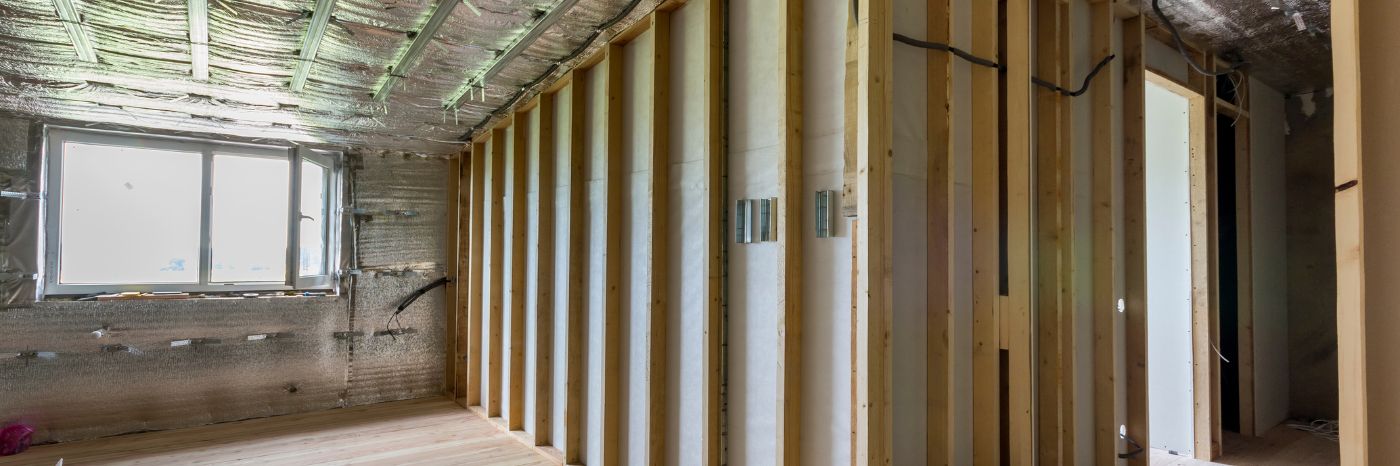
They ensure that building components remain permanently dry, mold growth is avoided, and heating energy does not escape in an uncontrolled manner.
Properties of Insulation Films for Interior Walls
Insulation films serve as a moisture barrier, thermal protection layer, and airtightness plane within the wall assembly.
In addition to general-purpose insulation films, so-called low-E or thermal films are used in interior walls.
Low-E films work through their very low emissivity (ε-value), which prevents thermal radiation from being absorbed or emitted by the film surface. Instead, infrared heat is reflected back into the room, thereby improving the thermal performance of the wall assembly. For this effect to be fully achieved, low-E films must always be installed with an adjacent air layer and correctly oriented toward the warm interior side.
The choice of the right film type depends on the use of the room, the moisture load, and the planned wall construction. It is crucial that films, adhesive tapes, and connections are coordinated with one another to ensure lasting airtightness.
| Function | Materials and Construction | Technical Properties | Characteristics |
|---|---|---|---|
| Vapor retarder film (diffusion-inhibiting) | Metallized plastic films (PET met, PP met) | Regulates moisture transport | Standard solution in drywall construction between heated rooms and cold zones |
| Vapor barrier (diffusion-tight) | Aluminum composite films (Alu/PE, Alu/PET) | Air- and vapor-impermeable | Used in bathrooms, kitchens, or rooms with high humidity |
| Reflective film / thermal protection film | Aluminum-laminated PET or PP films | Reflects thermal radiation | For improving the thermal insulation of interior walls and radiator recesses |
| Acoustic / heavy-duty film | PVC or bitumen heavy-duty films | Sound-absorbing | Serves as sound insulation, especially in partition walls or studios |
| Specialty films (protective and remediation films) | PE films, some with anti-mold or barrier coatings | Moisture- or chemical-resistant | For renovations, older buildings, or laboratories with elevated protection requirements |
The sd-value describes the resistance of a wall or film layer to water vapor diffusion and is calculated using the formula sd = μ · s.
Here, μ represents the material-specific diffusion resistance factor and s represents the thickness of the layer in meters.
The higher the sd-value, the more vapor-tight the film.
DIN 4108-3 distinguishes between:
- Diffusion-open: sd ≤ 0.5 m
- Diffusion-inhibiting: 0.5 m < sd < 1,500 m
- Diffusion-tight: sd ≥ 1,500 m
For interior walls, a diffusion-inhibiting system is generally required to control moisture migration and allow back-drying.
In practice, this means that the films must be selected so that they do not completely block moisture transport but rather slow it in a controlled manner. Only in this way does the construction remain sufficiently diffusion-open to release residual moisture and avoid long-term structural damage.
Influencing Factors
Factors influencing the effectiveness of insulation films in interior walls:
- Wall assembly and location: exterior wall vs. partition wall to unheated spaces (basement, stairwell)
- Moisture class of the room: bathroom/kitchen: vapor barrier preferred; living spaces: vapor retarders
- Climate region and temperature gradient: greater benefit with high temperature differentials (winter operation)
- Thermal bridges: corners, connections, roller shutter boxes: detailed sealing is critical
- Installation quality: overlaps, adhesive tapes, and penetrations must be executed in an airtight manner
The performance of insulation films depends not only on the material itself but significantly on correct installation and coordination with the overall wall assembly.
Application Areas
Insulation films for interior walls are used in many areas of interior construction, especially where temperature fluctuations or humidity could lead to problems.
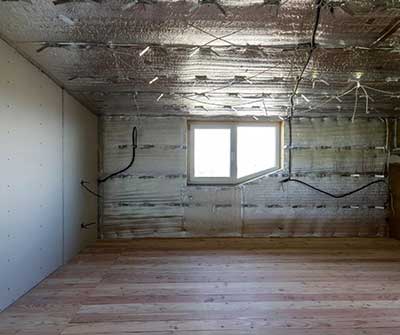
Insulation Films for Interior Walls
Drywall and plasterboard walls:
Vapor retarders prevent moisture from entering mineral wool insulation and protect against mold.
Interior walls adjacent to unheated spaces:
Films stabilize the moisture balance and reduce heat losses.
Wet rooms (bathroom, kitchen, sauna):
Vapor barriers provide reliable protection against water vapor exposure.
Radiator recesses and interior insulation on exterior walls:
Reflective films reflect thermal radiation and improve the U-value.
Acoustic applications:
Heavy-duty films serve as sound insulation in office, music, and residential areas.
Insulation films thus offer a flexible solution for virtually all wall types in interior construction. Especially in combination with smart insulation materials and energy-saving systems, they help increase living comfort and permanently reduce energy costs.
Advantages
Due to their versatile range of applications and high adaptability, insulation films are now considered a standard component in sustainable building concepts. They combine functionality, energy efficiency, and environmental awareness, making them an important part of modern interior construction and renovation solutions.
- Protection against moisture, mold, and condensation
- Improvement of energy efficiency and indoor air quality
- Reduction of thermal bridges and sound transmission
- Long-lasting stability through high-quality composite materials
- Compatible with drywall and renovation systems
Standards
Implementation in accordance with the relevant standards ensures lasting functional reliability and quality. The most important guidelines and standards for insulation films in interior wall applications:
| Standard/Guideline | Content | Relevance |
|---|---|---|
| DIN EN 13984 | Plastic and elastomer sheets; vapor barriers and vapor retarders | Governs sd-value, tightness, and testing procedures |
| DIN 4108-3 | Thermal protection and energy conservation; moisture protection | Authoritative for the planning of interior wall constructions |
| DIN 4102/EN 13501-1 | Fire behavior of building materials | Classification of films according to combustibility |
| DIN EN ISO 717-1 | Acoustics; sound insulation of interior walls | Relevant for the use of sound-insulating films |
| ISO 6946 | Calculation of the thermal transmittance coefficient | Basis for assessing the insulating performance of wall assemblies |
The standards listed above form the technical foundation for planning and execution. They ensure that product properties, material testing, and installation specifications are harmonized and comparable across Europe.
FAQ
-
How is a vapor retarder film installed on interior walls?
It is applied to the warm side of the insulation and sealed airtight.
Important connections, electrical outlets, and penetrations must be carefully sealed. -
Which film is suitable for bathroom walls?
In wet rooms, a true vapor barrier (sd ≥ 1,500 m) should be used to reliably retain water vapor. -
Can I request custom sizes and individual dimensions?
Yes, we offer both roll goods and cut-to-size pieces in standard and custom dimensions, which you can request individually.
Size
Our insulation films are available in standard widths and individual custom sizes. We deliver precisely tailored to your needs, from roll goods to custom cuts. Simply contact us with your inquiry.
Are you looking for the right films for your project? With our many years of experience, we support you not only with product selection but also with technical consulting for your construction project at AlFiPa. Get in touch with us for expert advice today!