
Food Packaging
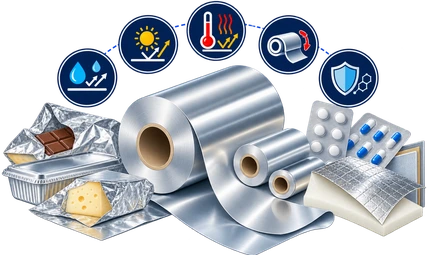
In food packaging, aluminum foil provides protection against light, oxygen and moisture and helps preserve aromas.

As an aluminum foil manufacturer, AlFiPa supplies the converting industry with rolls, sheets and custom-cut sizes – including small and medium quantities.
We tailor the alloy, temper, material thickness and surface finish to your requirements. Special dimensions can be considered on request.
Areas of application:
We manufacture aluminum foils with specific functional and visual properties for virtually all industrial applications. We supply all common dimensions and, on request, also small quantities.
Our aluminum foils are used by the converting industry and manufacturers of technical products.
Typical industries and applications:
In food packaging, aluminum foil provides protection against light, oxygen and moisture and helps preserve aromas.

As a barrier layer in pharmaceutical packaging, aluminum protects sensitive powders and granules against light, air and moisture.

As a facing layer in insulation films, aluminum foil reflects thermal radiation and protects insulation materials against water vapor ingress.

Aluminum-based laminates for protective bags and thermal covers protect sensitive goods against moisture and temperature fluctuations during transport.

Aluminum foil protects light-sensitive samples from exposure to light and is used to cover laboratory containers, including as a component of laminated films.

In insulation films for construction, aluminum acts as a vapor barrier and helps protect insulation materials against moisture.

In industrial applications, aluminum foil is used for electromagnetic shielding and moisture protection in cables, among other purposes.

As a blister lidding foil, aluminum foil securely seals and protects individual tablets and capsules while allowing them to be removed by pushing them through the foil.

When combined with bitumen, aluminum foil acts as a vapor barrier in flat roofs, while the bitumen protects the thin metal layer from damage.
Other Industries
This is just a selection of the most common industries and applications for our aluminum foil. We also supply other industrial sectors in Germany and abroad. Benefit from our many years of experience. We will be happy to provide free technical advice – contact one of our experts!
The most important mechanical properties of aluminum foils are tensile strength, yield strength and elongation. Particularly when aluminum is used as a base material for packaging, the surface gloss level plays an important role, including in enhancing the visual appeal of the product and supporting sales.
In food packaging in particular, the level of light transmission is one of the factors that influence product shelf life and help meet the food industry’s requirements for aroma protection.
Key barrier properties include the ability to act as a vapor barrier, vapor retarder or moisture barrier. These modern materials play a particularly important role in the construction industry.
The thermal reflectivity of aluminum foil, often used in laminated structures and particularly in insulation materials such as insulation boards, can help improve the energy efficiency of buildings.
The following surface finishes are available:
We tailor the appropriate converting and finishing processes to the desired appearance, function and subsequent processing requirements of your aluminum foil.
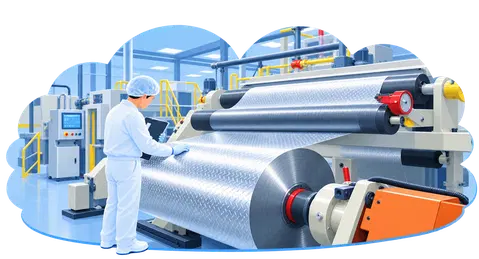
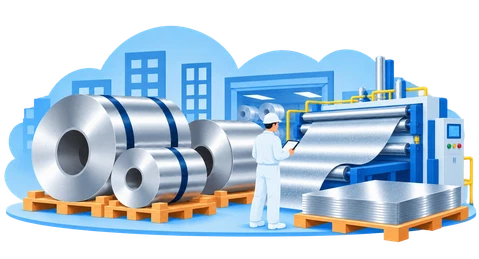
We supply aluminum foil in virtually all dimensions and material thicknesses within a thickness range of 6.0 to 4,000 µm (0.006 to 4 mm) and a width range of 8 to 2,080 mm.
We will be happy to assess other material thicknesses and dimensions on request.
Aluminum foil is specified by its alloy composition, which includes the proportions of other metals and metalloids present in aluminum alloys, such as:
We supply aluminum foil in the alloy of your choice, tailored to your intended application. These alloying elements are often present in very small quantities, yet they have a significant influence on the properties of aluminum foil.
Aluminum alloys are designated according to the European EN AW standard. Unlike the former German designation system, the aluminum content of an alloy is not immediately apparent. For example, under the German designation system, aluminum Al99.5 has an aluminum purity of 99.5%, whereas the designation EN AW 1050 does not immediately indicate the type of aluminum alloy. Consulting an alloy table provides clarification.
The most common alloys for thin aluminum foils according to the EN AW standard are 1050, 1200, 1235, 8079, 8011, 8111. Other alloys are available on request.






Different temper grades are achieved through the hardening of aluminum. Along with the alloy composition, this has a significant influence on the mechanical properties of aluminum foil. We supply aluminum in the temper grades required for your application.
The temper grades available from AlFiPa range from O/H111 (soft) to H18/19 (hard). Other available temper grades include H12 (quarter-hard), H14 (half-hard through strain hardening), H24 (half-hard through partial annealing), H16 (three-quarter-hard) and others.
We supply aluminum foil in rolls, in various dimensions, as well as in sheets or cut-to-size formats.
We supply aluminum foils in the following formats:
We also supply small and medium quantities.
We supply aluminum foils and cut-to-size formats in a wide range of dimensions.
We provide technical advice on all aspects of your requirements. As one of Europe’s leading manufacturers of functional aluminum foil, we offer you the benefit of our 40 years of experience. We support your product development and provide project planning assistance and technical advice.


Benefit from over 40 years of industry experience and product development based on this expertise. We supply aluminum foils in small quantities and offer you 100% quality and service.
We will be happy to advise you – send us your inquiry today!