

About the Author:
CEO at AlFiPa, responsible for operations as well as purchasing and sales. He is the primary contact for orders and deliveries within the company.
Insulation films
As a producer of insulation films, we offer in our range all types of aluminum and composite films that can be used for insulation and thermal protection. As one of the leading companies in the field of films for insulation, packaging, and industrial applications, we have a diverse product range, particularly in the area of insulation films.
Our insulation films
Construction
Roofs
Both flat and pitched roofs have their own specific insulation requirements. Preventing heat loss, sealing, and protection against wind and moisture are essential for roofs.Interior walls
Insulation for interior walls can contribute to both soundproofing and moisture regulation.Facades
Facade protection combines weather protection and improved energy efficiency, as the insulation shields against external influences while minimizing energy losses at the same time.Floors
Films installed beneath floors protect against rising moisture and thus prevent condensation. This keeps the floor structure stable and the insulation fully functional.Ceilings
Insulation films used in ceilings prevent heat loss between floors and play an important role in soundproofing.Foundations
For foundations, films serve as a sealing layer and protect against ground moisture. This prevents moisture from penetrating the building fabric and causing long-term damage.
Industry and technical applications
Shipbuilding & Offshore
Films in the maritime sector can ensure fire safety and minimize vapor diffusion, thereby preventing condensation, corrosion, and mold growth. With the right insulation, maintenance requirements can be reduced over the entire service life.Energy
In energy plants, insulation films provide reliable thermal and fire protection. The films minimize energy losses in turbines, pipelines, and technical systems, thereby extending the service life of the installations while also contributing to operational safety.Industrial plants and machinery
Machinery and plants are protected by insulation films against heat, moisture, and mechanical stress. Specialized films can dampen vibrations, insulate cables, and thus ensure and enhance reliability and efficiency in operation.Pipes
Insulation films for pipes offer more than just aesthetic benefits, as they provide essential protection against damage from mechanical stress, serve as thermal insulation, and have fire protection properties.Cables
Insulation films for cables act as a protective sheath and prevent short circuits from occurring. They also serve as shielding against electromagnetic fields for safe signal transmission, while additionally offering mechanical protection and shielding the conductors from moisture.
Functions of insulation films
Insulation films
Moisture sealing
Moisture sealing prevents rainwater, splash water, or ground moisture from penetrating the structure.
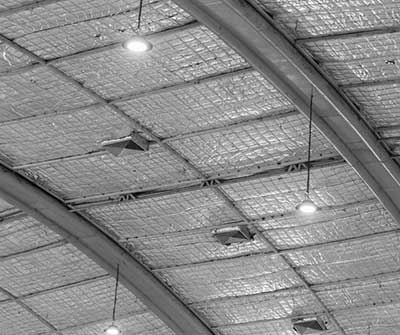
Vapor retarders and vapor barriers
Vapor retarders are installed components that inhibit the passage of water vapor, because unlike vapor barriers, which block water vapor almost completely (diffusion-tight), vapor retarders only have a delaying and reducing effect (diffusion-inhibiting). They ensure that moist warm air from the interior does not penetrate the insulation in an uncontrolled manner and cause condensation problems there.
Thermal insulation
Thermal insulation not only reduces heat loss and cold transfer but also prevents potential moisture damage and mold growth. With their low layer height, they are particularly sought after in building renovation. Insulation films are energy-efficient, space-saving, and cost-effective.
Protective function
There is a range of different film types with specific protective functions, for example in the areas of sound insulation, noise protection, and fire protection.
Films for sound insulation work through the targeted combination of different material properties. Heavy-duty films use their high weight for effective airborne sound insulation of walls and ceilings. Operational noise protection requires the use of sound-filtering materials to comply with both immission guideline values and workplace regulations.
Structural fire protection in industrial construction is also subject to strict regulations and guidelines that ensure not only fire protection but also the structural stability of buildings. These include requirements for containing the spread of fire and smoke gases as well as maintaining building stability.
Insulation film processing techniques
Insulation films
There are various types of processing techniques for insulation films:
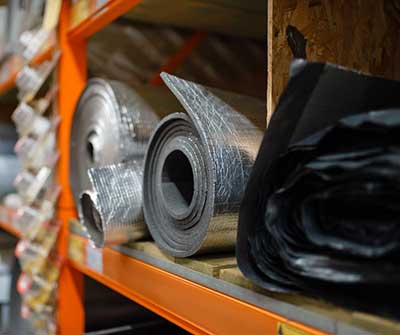
Lamination refers to the process in which insulation films are bonded with other materials such as paper, cardboard, aluminum, textiles, or insulation materials to form a composite material. This is usually done using special adhesives, adhesive lacquers, or heat-sealing processes. The bonding takes place under pressure and often at elevated temperatures to ensure a permanent bond.
Self-adhesive films are insulation films equipped with a self-adhesive layer, which simplifies processing. They require no additional adhesives and are applied directly to the designated areas.
In addition, there are further processes such as thermal lamination, wet lamination, structural embossing, and others.
Installation options for insulation films
Installation is usually carried out by bonding the film flat onto the substrate. The correct temperature, humidity, and uniform contact pressure are crucial to avoid wrinkling and air pockets.
For self-adhesive films, the protective layer is peeled off and the film is applied directly.
For more complex applications, additional process steps such as primer application, preheating, and edge activation are required to optimize adhesion strength and ensure the best possible quality.
Relevant standards and norms
Various norms and certifications at international and European level apply to insulation films and must be observed. Compliance with quality, safety, and environmental standards must not be neglected. However, the applicable regulations differ depending on the category of film and the area of application.
Relevant standards include:
- REACH Regulation and RoHS Directive (freedom from harmful substances and material requirements)
- UL certifications (safety testing)
- IEC and EN standards (electrical safety and technical testing criteria)
- ISO 9001 (quality management) and ISO 14001 (environmental management)
These standards ensure that insulation films meet legal requirements and are suitable for use in various applications.
Choosing the right insulation film
Not sure which insulation film is right for your product? No problem! Here we offer you a direct comparison of the common product types:
| Product type | Application area | Thermal insulation | Moisture protection | Sound insulation | Fire protection | Special features |
|---|---|---|---|---|---|---|
| Reflective film (aluminum-laminated) | Roof, walls, interior finishing | High | High | Low | Limited | Space-saving, reflects thermal radiation |
| Vapor barrier film (PE/PP) | New construction, renovation, floors, ceilings | Medium | Very high | Low | Low | Prevents condensation, ensures an airtight building envelope |
| Acoustic film | Interior spaces, studios, partition walls | Medium | Medium | Very high | Limited | High sound absorption, improves room acoustics |
| Fire protection film | Industrial plants, engine rooms | Medium | High | High | Very high | Flame-retardant according to DIN/EN standards, suitable for industrial use |
| Multi-layer composite film | Roofs, facades, surfaces with combined requirements | Very high | High | High | High | Combines multiple protective functions in one material |
| Vibration-damping film | Machinery, pipelines, metal cladding | Low | Medium | Limited | Limited | Reduces structure-borne noise and vibrations, ideal for plant engineering |
Further information
Find out even more details about the following films:
Insulation films for industrial plants
Insulation films in construction
Insulation films in industrial construction
Insulation films FAQ
What is the difference between insulation film and insulation material?
Insulation films (e.g. aluminum) reflect thermal radiation and are thin. Insulation materials (such as mineral wool) work through mass and insulate against heat conduction/convection – they are thicker and often serve as the primary insulation.How fire-retardant are insulation films?
Only special films (e.g. UL 94 V0 or DIN 4102-B1 certified) are classified as flame-retardant. Standard films usually burn and do not provide fire protection on their own.How effective are insulation films for sound insulation?
Acoustic films (e.g. made of PVB) can reduce sound by approximately 10 dB but are less effective than solid insulation materials.Which insulation films are specifically suitable for pipelines?
PE insulation (good for thermal/sound insulation) or PVC (more for surface protection) are suitable for pipelines. PE is the standard for heating pipes.What is needed for effective roof insulation with films?
– Vapor retarder films (interior side, against moisture)
– Roofing underlays (exterior side, rainproof but vapor-permeable)
– Climate membranes (adaptive)What film solutions are available for walls?
– Vapor retarder films (moisture protection)
– Soundproofing films (limited effectiveness)
– Decorative films (aesthetics/protection)Can insulation films be retrofitted?
Yes, usually without any issues (e.g. on windows, walls). Important: Clean surface required! With glass, caution is advised – thermal stress can risk breakage.
Consulting
AlFiPa is one of the leading companies in Europe when it comes to films.
Are you looking for a suitable insulation film? Our team offers you the right consulting. Contact us now to get your questions answered!
Specialized insulation solutions

Moisture Sealing
Moisture is one of the greatest threats to buildings and technical installations. When water penetrates components uncontrollably, it can lead over time to corrosion, mold growth, or structural material degradation. Proper sealing is therefore...
Thermal Insulation Films
Thermal Insulation
Effective thermal insulation not only reduces heat loss and cold transfer but also contributes to energy efficiency and environmental protection while preventing potential moisture damage and mold...

Vapor Barriers and Vapor Retarders
What are vapor barriers and vapor retarders?
Vapor barriers prevent and vapor retarders reduce the penetration of moisture , helping protect against condensation, mold, and corrosion. This is important not only for roofing, piping, and...
As a specialist for insulation films, we are your point of contact for thermal, moisture, and sound insulation as well as noise and fire protection. We offer solutions for all insulation requirements in construction and also provide customized films for the insulation of industrial plants. Contact us!